This article is general legal information, not legal advice. Personal injury law varies significantly from state to state, and every case turns on its own facts. Nothing here creates an attorney-client relationship, and no outcome is promised or implied. Consult a licensed attorney in your state before making decisions about your claim.
A pedestrian accident lawyer handles the most physically lopsided cases in injury practice. A person walking has roughly a hundred and fifty pounds of soft tissue and bone. The vehicle that strikes them has three or four thousand pounds of steel moving at speed. There is no crumple zone, no seat belt, no airbag. The energy goes directly into a human body, and then that body usually hits the ground or the windshield a second time.
That imbalance shapes everything about these claims — the severity of the medical picture, the length of the recovery, and the intensity with which the driver’s insurer will look for a way to shift blame onto the person who was walking.
Why Pedestrian Injuries Are So Severe
The typical pedestrian strike produces a recognizable injury pattern that trauma teams see repeatedly. Understanding it matters because the medical picture drives both treatment planning and how a claim gets documented.
The three-impact sequence
- Bumper contact. On a passenger car, the bumper strikes at roughly knee or lower-leg height, producing tibia, fibula, and knee injuries. Taller vehicles with higher front ends strike the pelvis, abdomen, or chest instead — a meaningful difference in outcomes.
- Hood and windshield contact. The body rotates onto the vehicle. Pelvic fractures, rib fractures, abdominal organ injuries, and head strikes on the hood edge, A-pillar, or glass.
- Ground contact. The body is thrown and lands. Second head impact, spinal injuries, shoulder and wrist fractures from bracing, and road abrasion injuries.
Injuries that shape these cases
- Traumatic brain injury, from mild concussion through severe. Frequently the most consequential injury and the hardest to document.
- Complex lower extremity fractures often requiring multiple surgeries and hardware.
- Pelvic and acetabular fractures with long non-weight-bearing recovery periods.
- Spinal fractures and disc injuries.
- Internal organ damage, particularly spleen, liver, and lung.
- Degloving and severe soft tissue injuries requiring grafting.
- Post-traumatic stress and anxiety about crossing streets, which is real and often overlooked in the record.
Two features of this injury profile matter legally. First, the treatment arc is long, which means the full extent of the harm is not knowable for many months. Second, brain injury and chronic pain are the two categories most aggressively contested, precisely because they are the least visible on imaging.
Crosswalks and Right of Way
Right-of-way rules vary by state, but the general framework across most of the country follows a consistent logic.
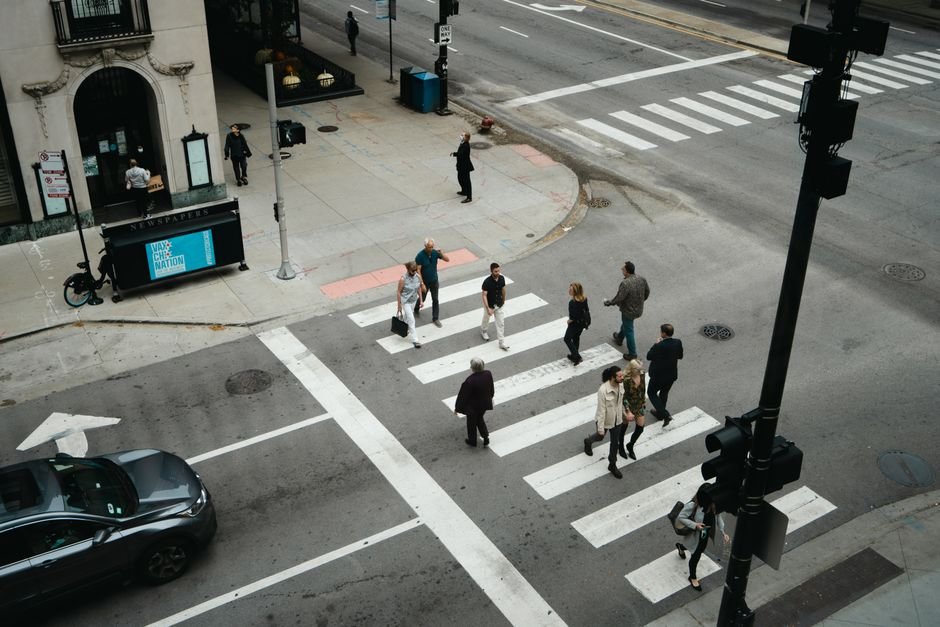
Marked crosswalks at signalized intersections
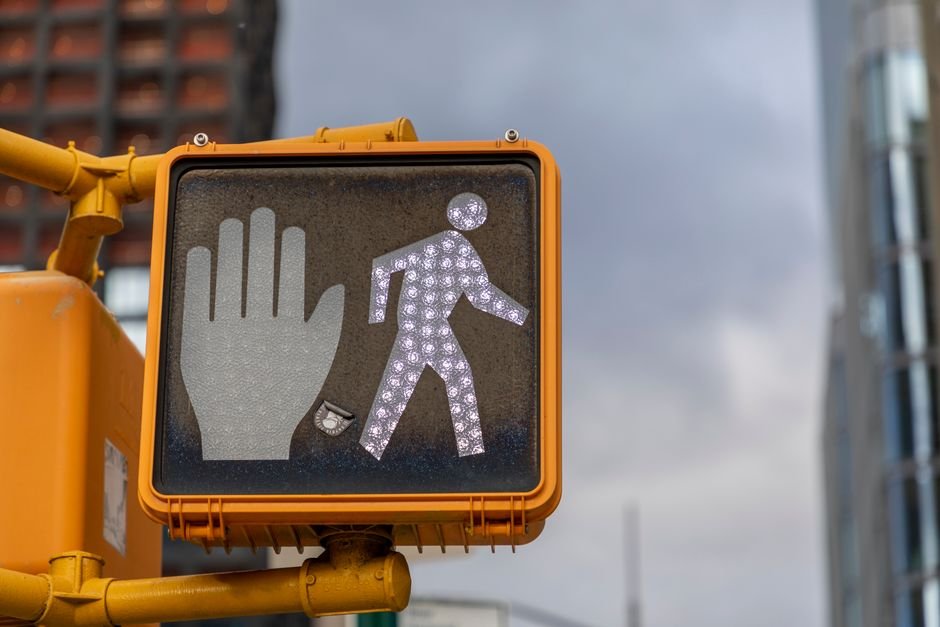
The pedestrian signal governs. A pedestrian entering on WALK has the right of way. Turning vehicles facing a green light must yield to pedestrians lawfully in the crosswalk — a rule drivers violate constantly, because a driver making a left turn is watching for gaps in oncoming traffic rather than looking at the crosswalk they are about to enter.
Unmarked crosswalks
This is the point most people do not know. In most states, an unmarked crosswalk legally exists at intersections wherever sidewalks or curb lines would logically continue across the road. No paint required. A pedestrian crossing at a corner with no painted lines is often still in a legal crosswalk, and drivers are required to yield.
Mid-block crossings
Outside a crosswalk, the pedestrian generally must yield to vehicles. That is not the same as being at fault for the collision. A driver still has a duty to keep a proper lookout and to exercise due care to avoid striking any pedestrian, and that duty does not evaporate because someone crossed where they should not have.
Where fault-sharing arguments come from
Insurers reach for a small set of recurring arguments, and knowing them in advance is useful:
- The pedestrian crossed mid-block or against a signal.
- The pedestrian stepped off the curb suddenly and gave the driver no chance to react.
- The pedestrian was wearing dark clothing at night.
- The pedestrian was looking at a phone or wearing headphones.
- The pedestrian had been drinking.
Some of these carry weight and some do not. Most states apply a comparative fault framework, and shared responsibility usually reduces recovery rather than eliminating it — the mechanics of that are covered elsewhere on this site. The point here is that a pedestrian accident lawyer expects these arguments in nearly every case, including cases where the pedestrian did nothing wrong, and answers them with physical evidence rather than argument.
Signal Timing, Speed, and Driver Inattention
The signal timing question nobody asks
Pedestrian signals are timed using engineering assumptions about walking speed. Those assumptions have historically been faster than what many older adults, children, and people using mobility aids can actually manage. Guidance has moved toward slower design speeds, but existing installations were timed under earlier standards and are not always retimed.
The practical result: a pedestrian who entered lawfully on WALK can still be in the roadway when the conflicting signal turns green. In a case involving an older pedestrian struck late in the cycle, obtaining the signal timing plan and the controller data is not a technicality — it can convert an apparent pedestrian violation into a lawful crossing.
Speed changes everything
Vehicle speed affects pedestrian outcomes non-linearly. Stopping distance grows with the square of speed, and impact energy does too. The difference between a strike at low neighborhood speeds and one at arterial speeds is frequently the difference between survivable injuries and fatal ones. Reconstruction that establishes actual travel speed is therefore central to both liability and damages.
Inattention and modern vehicle design
- Phone use. Records and app data can establish device activity in the seconds before impact.
- The left-turn conflict. Drivers scanning for gaps in oncoming traffic routinely fail to see a pedestrian already in the crosswalk.
- A-pillar obstruction. Structural pillars create real blind spots, especially during turns, and a driver who did not move their head may never have seen anything.
- Front-end height. Taller vehicle hoods reduce forward visibility of small children directly in front and change the injury mechanics on impact.
- Right turn on red. Drivers looking left for a gap while rolling right, into a crosswalk they never checked.
- Infotainment interaction. Touchscreen systems requiring visual attention while the vehicle is moving.
Visibility, Lighting, and Time of Day
A disproportionate share of serious pedestrian collisions happen in darkness. That fact gets used against pedestrians constantly — the dark clothing argument — and it deserves a careful answer.
| Insurer argument | What the investigation examines |
|---|---|
| “The pedestrian was invisible in dark clothing” | Actual illumination at the impact point, measured on site under comparable conditions |
| “There was no time to react” | Sight lines, approach geometry, and reconstruction of available perception-reaction distance |
| “Streetlights were out” | Municipal maintenance records and outage reports, which may add a public-entity defendant |
| “The pedestrian darted out” | Physical evidence of the pedestrian’s path, impact point, and throw distance |
| “Headlights were on and adequate” | Headlight aim, condition, and whether high beams were appropriate for the setting |
| “Glare made it impossible to see” | Sun position and angle at the time of day, or oncoming headlight geometry |
Roadway design itself sometimes belongs in the analysis. Long stretches of arterial road with transit stops and no marked crossing for a quarter mile produce predictable mid-block crossings. Where a public entity created or ignored that condition, a claim against the municipality or state may exist — subject to notice requirements and immunity rules that are strict, short, and unforgiving. That possibility alone is a reason to consult a pedestrian accident lawyer early rather than after the driver’s insurer responds.
Hit-and-Run Scenarios
Pedestrian collisions produce a higher rate of drivers leaving the scene than most vehicle-to-vehicle crashes. The driver may not be certain what they hit, may be impaired, may be unlicensed or uninsured.
Identifying an unknown driver
- Vehicle debris at the scene. Mirror housings, grille fragments, headlight lenses, and trim pieces frequently carry part numbers that narrow the vehicle to a make, model, and year range.
- Paint transfer. Paint on clothing or on the roadway can be analyzed and matched to manufacturer codes.
- Camera canvassing. Businesses, residential doorbell cameras, transit vehicles, and traffic cameras along the likely escape route. This must happen within days, because most systems overwrite quickly.
- Body shop notification. Repair facilities in the area may be alerted to front-end damage consistent with the incident.
- Parts orders. A specific replacement part ordered locally shortly after the crash is a usable lead.
- Witness accounts. Even a partial plate combined with a vehicle description can be enough.
A pedestrian accident lawyer usually starts this work in parallel with police, because private canvassing can move faster. Where the driver is never identified, an injured pedestrian is not necessarily without recourse. A pedestrian struck by an unknown vehicle may be able to look to their own auto coverage even though they were on foot, and coverage may also extend through a resident household member’s policy. The specifics belong to the insurance side of the analysis, but the practical point is worth stating: do not assume a hit-and-run means no claim exists. Report to police promptly, because a timely report is commonly a condition of that coverage.
Children and Older Pedestrians
Child pedestrians
Children are struck in predictable circumstances: near schools, at bus stops, in residential streets, darting between parked cars, and in driveways and parking lots where reversing vehicles cannot see them.
The legal treatment differs from adults in ways that matter. Most states hold children to a standard of care measured against children of similar age, intelligence, and experience — not against a reasonable adult. Some states apply a presumption that very young children cannot be negligent at all. Drivers are also expected to exercise heightened caution where children are foreseeably present, which is why school zones and residential streets carry different expectations than a highway.
Damages analysis is different too. A child with a serious brain injury has no wage history to reference, so future losses are projected through educational testing, vocational expert testimony, and life care planning. These claims develop slowly by necessity, because the full effect of a pediatric brain injury may not be apparent for years.
Older pedestrians
Older adults are struck at high rates relative to their share of walking trips, and they suffer far worse outcomes from comparable impacts. Slower crossing speed, reduced peripheral vision, hearing loss, and mobility limitations all raise exposure. Reduced bone density and pre-existing conditions make identical forces far more damaging.
The recurring defense theme is that a pre-existing condition, rather than the collision, explains the current state. The established answer is that a defendant takes the plaintiff as they find them — a person’s fragility does not reduce responsibility for the harm caused. Proving it takes clear before-and-after evidence: prior medical records establishing baseline function, and testimony from people who knew the person’s daily capabilities before the crash.
Why Reconstruction Matters More Here
In a two-vehicle collision, the vehicles themselves record much of the story through damage patterns and, often, event data. In a pedestrian strike, one of the two participants is a person who may have no memory of the event and who cannot describe what happened. Reconstruction fills that gap, which is why a pedestrian accident lawyer brings in an expert early rather than after the vehicle has been repaired.
| Evidence source | What it establishes | How fast it disappears |
|---|---|---|
| Event data recorder | Pre-impact speed, braking, throttle, sometimes steering | Can be lost when the vehicle is repaired or sold to salvage |
| Throw distance and rest position | Impact speed, calculated from established relationships | Documented only if the scene was measured before clearing |
| Vehicle damage profile | Impact point, pedestrian orientation, and body position | Gone once the vehicle is repaired |
| Roadway evidence | Pre- and post-impact braking, path of travel | Days to weeks, sooner in rain or heavy traffic |
| Surveillance and dashcam video | The actual sequence, often decisively | Frequently overwritten in one to two weeks |
| Signal timing and controller logs | Whether the pedestrian phase was active | Retention depends on the municipality; request early |
| Site illumination measurements | Real visibility conditions at the impact point | Reproducible later, but only if lighting is unchanged |
What a reconstructionist can typically establish
- Vehicle speed at impact, derived from multiple independent methods.
- How long the pedestrian was visible and within the driver’s field of view before impact.
- Whether the driver had sufficient distance to perceive, react, and stop.
- The pedestrian’s path and orientation at impact, which frequently contradicts a “darted out” account.
- Whether the vehicle braked at all before contact.
That fourth point does real work. A pedestrian struck on the left side while facing forward was walking across, not stepping suddenly into the lane. The body tells the story the driver’s statement does not.
Frequently Asked Questions
Do pedestrians always have the right of way?
No. Pedestrians generally have the right of way in marked and unmarked crosswalks and when a walk signal is displayed. Outside those situations they typically must yield to traffic, though drivers still owe a duty of due care to avoid striking anyone.
What if I was crossing mid-block when I was hit?
You may still have a claim. Crossing outside a crosswalk does not end a driver’s obligation to maintain a proper lookout and drive at a safe speed. It commonly becomes an argument about shared responsibility rather than an automatic bar.
The driver fled and was never found. Do I have any options?
Possibly. Physical evidence, camera canvassing, and body shop leads identify some hit-and-run drivers. Where the driver is never located, coverage under your own or a household member’s auto policy may respond even though you were walking. Report to police promptly.
Is an unmarked crosswalk really a crosswalk?
In most states, yes. A legal crosswalk generally exists at an intersection where sidewalk or curb lines would continue across the roadway, whether or not paint is present. This surprises drivers and pedestrians alike.
What if a child was the one struck?
Children are generally held to a standard measured against children of similar age and experience rather than an adult standard, and some states presume very young children cannot be negligent. Drivers are also expected to use heightened caution where children are foreseeably present.
Why does the driver’s insurer keep asking about my clothing?
It is setting up a visibility defense. The answer is measurement rather than argument: actual illumination at the impact point, sight lines, headlight condition, and reconstruction of the distance at which the pedestrian became visible.
How quickly should I act after a pedestrian crash?
Quickly. Surveillance video is often overwritten within one to two weeks, roadway evidence disappears in days, and the striking vehicle may be repaired or sold to salvage before anyone inspects it or downloads its data.
Final Thoughts
Pedestrian cases combine the most serious injuries in injury practice with the most aggressive blame-shifting. The person who was walking usually cannot describe what happened, often because of the head injury the collision caused, and the only other witness is the driver whose insurer is paying for the defense.
That is why the physical record carries so much weight, and why timing matters. If you or a family member was struck by a vehicle, the practical priorities are direct: get complete medical evaluation including a documented neurological assessment, make sure a police report exists, photograph injuries and the scene as soon as anyone is able, identify nearby cameras within days, and prevent the striking vehicle from being repaired or scrapped before it is examined. Then talk to a pedestrian accident lawyer who has worked with reconstruction experts on these specific cases. Consultations are typically free, and the evidence that decides the case is disappearing while the decision is being made.
Disclaimer
This article is provided for general informational purposes only and does not constitute legal advice. Pedestrian right-of-way rules, crosswalk definitions, fault-allocation systems, standards applied to child pedestrians, claims against public entities, notice requirements, and filing deadlines vary considerably by state and change over time. Reading this article does not create an attorney-client relationship. No result is guaranteed, and past outcomes do not predict future ones. Always consult a licensed attorney in your jurisdiction about your specific circumstances before acting or refraining from acting on any information here.